Chambray vs denim: same cotton, different weave — and why it matters
Chambray is a plain weave with a colored warp and white weft on both faces; denim is a warp-faced twill with the indigo yarn floating on the surface. Chambray runs light (roughly 110-160 gsm, soft drape, no fade), denim runs heavy (roughly 300-500 gsm in jacket weights, structured, fades with wear). For shirts, chambray is the breathable warm-weather choice and denim the structured layering one; for jackets, twill wins by default because plain weave cannot take the abrasion.
Same yarns, different interlacing
The two weaves differ at the single crossing point of two yarns. In a plain weave, warp and weft yarns alternate one up, one down — the simplest, most balanced interlacing fabric allows. Chambray colors this balanced grid asymmetrically: the warp is dyed (classically indigo), the weft is left white or undyed. Because the grid is one-to-one, the white weft shows equally on the face and the back, and the colored and white yarns sit side by side. From arm’s length the fabric reads as a single even blue with a faint heathered texture — the white yarn mixed into every square millimeter.
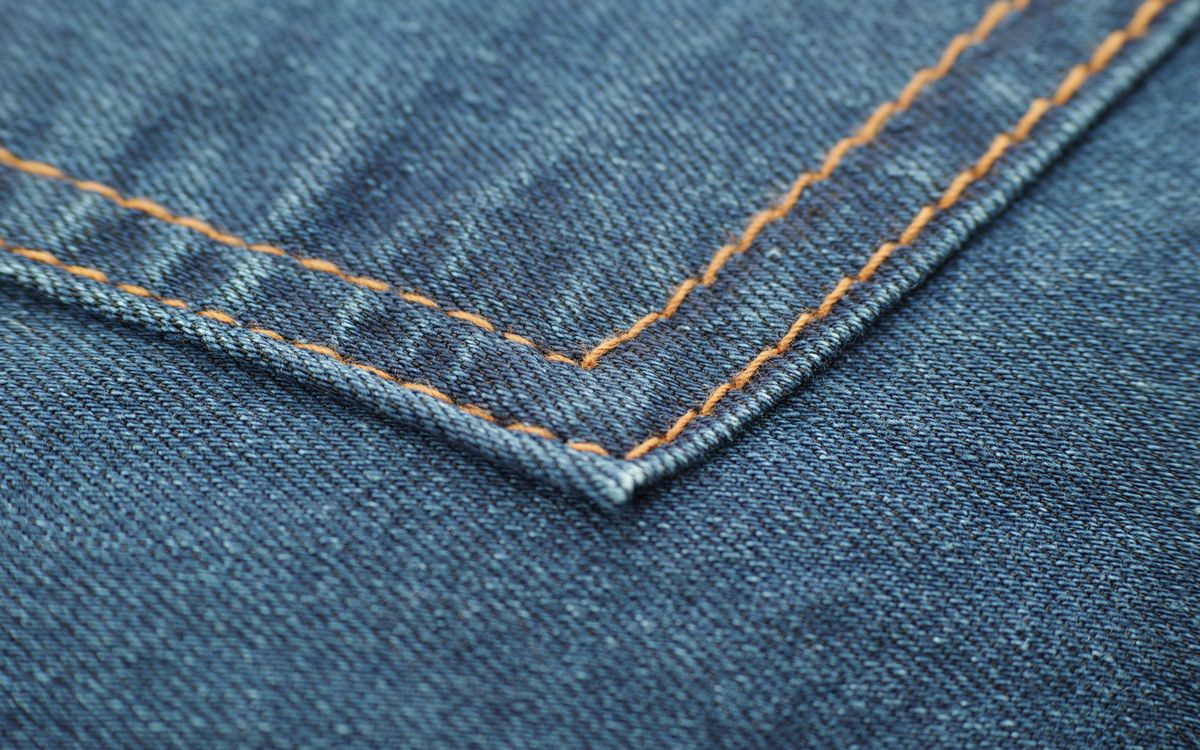
Denim is a twill, specifically a warp-faced one, most commonly a 3x1: each colored warp yarn passes over three weft yarns and under one. The warp dominates the surface. Three of every four yarns you touch on the face are indigo-dyed; on the back, the white weft dominates instead. That asymmetry is why denim is blue outside and pale inside — and it is the direct cause of everything else that follows: the fading, the weight, the stiffness, the drape.
| Property | Chambray | Denim |
|---|---|---|
| Weave | Plain, 1x1 interlacing | Twill, typically 3x1 warp-faced |
| Yarn coloring | Indigo warp, white weft, balanced | Indigo warp dominates face; white weft shows on back |
| Back of fabric | Same heathered blue as face | Paler than face; whitish |
| Surface texture | Fine, slightly grainy, even | Diagonal ridges (wale lines) |
| Where it lives | Shirts, dresses, linings | Jeans, jackets, heavy workwear |
Why chambray is lighter: the weight numbers
Plain weave simply has less yarn per square centimeter. In a 1x1 grid every yarn is fully interlaced, so yarn cannot be packed densely without the fabric turning stiff; in a 3x1 twill, warp yarns float over three wefts at a time, allowing more yarn per area before the weave chokes. The result is a systematic weight gap:
| Garment type | Chambray, typical | Denim, typical |
|---|---|---|
| Shirting | 110-160 gsm (3.2-4.7 oz) | 180-280 gsm (5.3-8 oz) for shirt-weight denim |
| Jacket / outerwear | rarely made | 300-450 gsm (9-13 oz) |
| Trousers | rarely made | 340-550 gsm (10-16 oz) |
The gsm to oz conversion is one fixed multiplier (33.9), so these ranges translate directly — and the same weight-to-wearing logic that governs t-shirts applies to wovens. In practice the split is stark: chambray is a shirting fabric almost exclusively, denim a bottom-weight and jacket-weight fabric. A chambray shirt weighs roughly a third of what an equivalent denim shirt would, and no manufacturer bothers making a proper chambray trucker jacket — plain weave lacks the abrasion resistance to survive the job the twill was invented for.
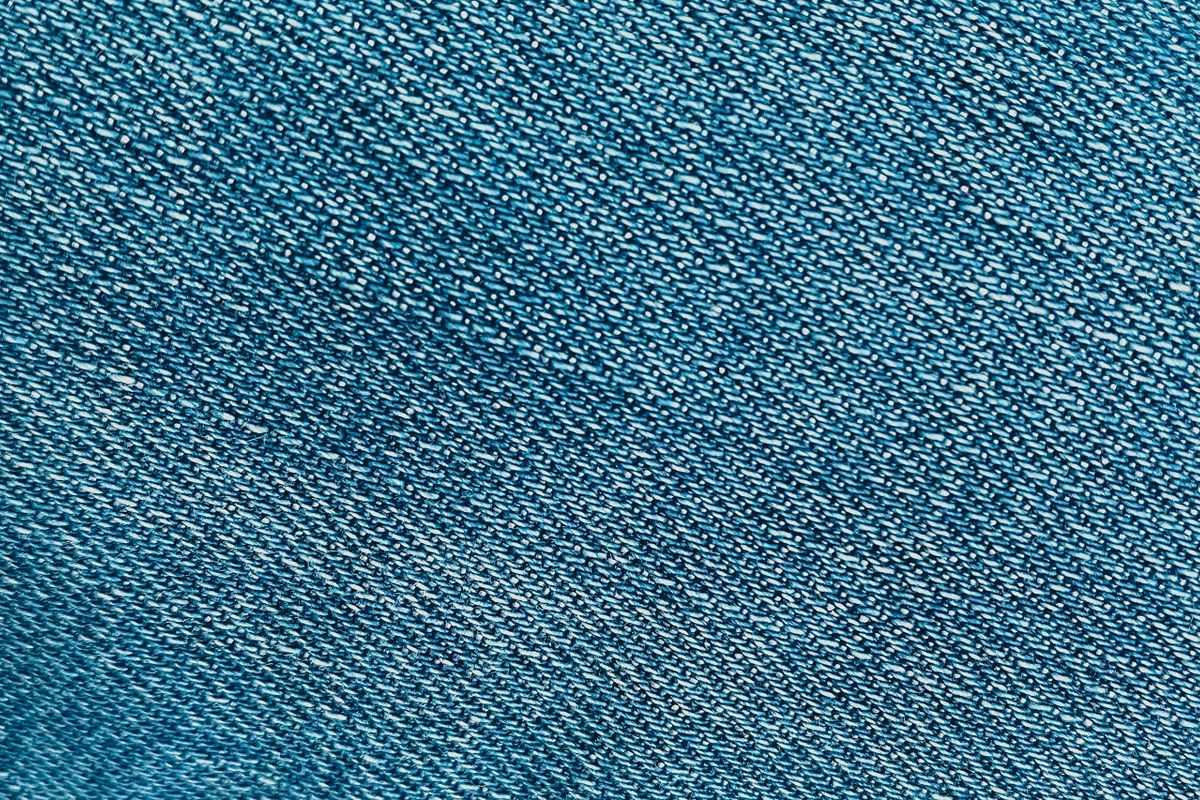
The fade question: why denim develops character and chambray does not
Indigo is a surface dye — it coats the yarn’s outer layer rather than penetrating the core, which is a byproduct of how indigo chemically bonds (it oxidizes back onto the fiber exterior). Combine a surface dye with a warp-faced twill and you get denim’s signature behavior: the indigo yarns sit proud on the fabric face, exactly where friction lives. Hips, knees, cuffs, and wallet corners abrade the dye coating, exposing the pale yarn core beneath, and the fabric maps its wearer’s life in worn marks.
Chambray inherits the same surface-dyed yarn but buries it in a balanced weave. Each indigo warp yarn is crossed by white weft yarns on both faces, sheltered within the fabric structure rather than exposed on it. There is no raised dye layer to rub off, so there is no fade pattern — a chambray shirt years old is a softer, paler-uniform version of itself, not a documented biography. Neither behavior is better; one fabric is designed to record wear and the other to ignore it. If you like patina, only twill delivers it.
Drape, breathability, and what they feel like on
Weave determines geometry, and geometry determines hand. Chambray’s open 1x1 grid has more visible interstices — actual air gaps between yarns — so air moves through it readily, and the fabric bends at every crossing point with almost no internal resistance. On the body: soft, fluid drape, quick to wrinkle softly rather than crease sharply, noticeably cooler in heat, and lighter against the skin than nearly any other blue-cotton option.
Denim’s floats do the opposite. With warp yarns lying flat across three wefts at a stretch, the fabric resists bending and holds a shape — crease, pleat, or silhouette. The tighter packing blocks wind far better than the open plain weave, and the mass (a 12 oz jacket runs about 407 gsm) gives it a standing structure that a chambray panel cannot mimic. The standard break-in arc follows from this: new denim is stiff because the floats and sizing resist movement, and it softens as wear bends those floats thousands of times.
The practical wardrobe consequence: the two fabrics occupy different seasons. Chambray is a hot-weather shirt and a warm-weather layer; denim shirt-weight fabric is a mid-season layer, and jacket-weight denim is transitional outerwear. Substituting one for the other changes the garment’s climate more than its look.
Three current pieces, read as fabric
Because the chambray-versus-denim choice ultimately resolves into buying one specific garment or another, it helps to look at real, currently sold examples of each weight class. Three widely available pieces cover the span well:
J.Crew Factory Classic Chambray Shirt
Uniqlo Denim Jacket
Levi’s Essential Trucker Jacket
The J.Crew Factory chambray is the plain-weave case in its purest form — 100% cotton shirting with no stated fabric weight, which is typical of chambray listings and consistent with the light weights the weave produces. The Uniqlo jacket, at a stated 10 oz (about 340 gsm), is the light end of denim outerwear, chosen precisely because it is the most wearable denim jacket for people who find heavier twill stiff. The Levi’s Essential Trucker, at a stated 12 oz (about 407 gsm), is the contemporary standard-issue denim weight — noticeably more structure than the Uniqlo, still far below the 14-14.7 oz of vintage-spec truckers. What the comparison shows is the weave spectrum in product form: as weight rises within twill, structure rises and drape falls, while the single plain-weave entry sits in a different category of garment altogether.
| Specification | J.Crew Factory Classic Chambray Shirt | Uniqlo Denim Jacket | Levi’s Essential Trucker Jacket |
|---|---|---|---|
| Weave | Plain (chambray) | Twill (denim) | Twill (denim) |
| Stated fabric weight | Not stated | 10 oz / ~340 gsm | 12 oz / ~407 gsm |
| Fiber content | 100% cotton | Cotton denim | 100% cotton denim |
| Garment type | Button-down shirt | Trucker-style jacket | Trucker jacket |
| Fade behavior | No fade pattern develops | Fades slowly at friction points | Fades characteristically |
Caring for each without ruining the point
The two weaves also want different care, for structural reasons. Chambray’s balanced plain weave tolerates ordinary machine washing well; its risk is shrinkage and color bleed from the indigo warp, both controlled by cold water and air drying. Wash it like any fine cotton shirt — and since the heathered look comes from white weft yarns, aggressive hot washing slightly whitens the fabric over time, which some people like and some do not.
Denim’s care debate is larger because the fade behavior is the point of the fabric. Frequent machine washing resets the indigo wear pattern uniformly and softens the twill prematurely; infrequent washing preserves contrast between worn and unworn areas. Cold water, inside out, low spin covers most of it — the fuller reasoning lives in the denim washing question, which deserves its own treatment rather than a slogan. Both fabrics share one rule: heat is the enemy of fit. Tumble drying a cotton-heavy garment at high temperature is the fastest route to a size smaller — the same heat aversion is why merino is never tumble-dried — and the care row on the label usually states the safe ceiling, as covered in [the guide to reading fabric labels](/articles/how-to-read-a-fabric-label/.
The label check: telling them apart in a store
In person, three checks separate the two weaves in under a minute. First, the back: chambray’s reverse matches its face (heathered blue), denim’s reverse is markedly paler. Second, the diagonal: hold denim up to light at an angle and the twill wale lines are visible; chambray shows none. Third, the drape test: crumple a handful and release — chambray falls into soft wrinkles, denim holds the crumple briefly. Combined with the fiber line on the label, these checks settle any listing that fails to name its weave, which is most of them. The one thing no in-store check replaces is the weight figure; where a listing omits both weave and gsm, the garment photographs usually betray the answer — a shirt is plain-weave territory, a jacket is twill, and the borderline pieces are exactly where the label matters most.
The picks
Some links below are affiliate links — we may earn a commission at no extra cost to you.
J.Crew Factory Classic Chambray Shirt
Pure plain-weave chambray in 100% cotton — the lightest, most breathable option of the three, and the one that dresses up under a sweater as easily as it wears on its own.
Uniqlo Denim Jacket
A stated 10 oz denim, the lightest twill weight of the three, which makes it the easiest denim jacket to actually wear — soft out of the box without the vintage-spec stiffness.
Levi's Essential Trucker Jacket
12 oz cotton twill in the Type III trucker pattern — the contemporary standard weight that balances structure, fade potential, and everyday wearability.
Comparison
| Specification | J.Crew Factory Classic Chambray Shirt | Uniqlo Denim Jacket | Levi's Essential Trucker Jacket |
|---|---|---|---|
| Weave | Plain weave (chambray) | Twill (denim) | Twill (denim) |
| Stated fabric weight | Not stated | 10 oz (~340 gsm) | 12 oz (~407 gsm) |
| Fiber content | 100% cotton | Cotton denim | 100% cotton denim |
| Garment type | Button-down shirt | Trucker-style jacket | Trucker jacket |
| Fade behavior | No fade pattern develops | Fades slowly at friction points | Fades characteristically over time |
Specifications as listed on the makers' product pages, checked November 2026.
Sources
- J.Crew Factory product page for the Classic Chambray Shirt (factory.jcrew.com, item CF818), checked November 2026
- Uniqlo product page for the Denim Jacket, for the stated 10 oz weight (uniqlo.com), checked November 2026
- Levi's Essential Trucker Jacket product and retail listings, for the stated 12 oz cotton denim weight (levi.com and retailer pages), checked November 2026
Frequently asked questions
- Is chambray just lightweight denim?
- No. The difference is structural, not just weight. Chambray is a plain weave where one colored warp yarn crosses one white weft yarn per interlacing; denim is a twill where the colored warp yarn floats over two or more weft yarns. Chambray is usually lighter, but a heavy chambray would still not be denim.
- Why does denim fade but chambray stays flat?
- Denim's twill structure leaves the indigo-dyed warp yarns sitting on the fabric surface, where friction slowly abrades the dye. Chambray's plain weave locks each colored yarn between white weft crossings on both faces, so there is no raised dye layer to wear away and no fade pattern develops.
- Can you substitute chambray for denim in an outfit?
- Visually yes for shirts, since both read as 'blue cotton workwear,' and a chambray shirt is the standard warm-weather stand-in for a denim one. Structurally no for jackets: chambray lacks the abrasion resistance and wind-blocking density of a jacket-weight twill, which is why chambray jackets are rare.