Leather vs Suede vs Full-Grain: the tannery terms, mapped to what you can buy
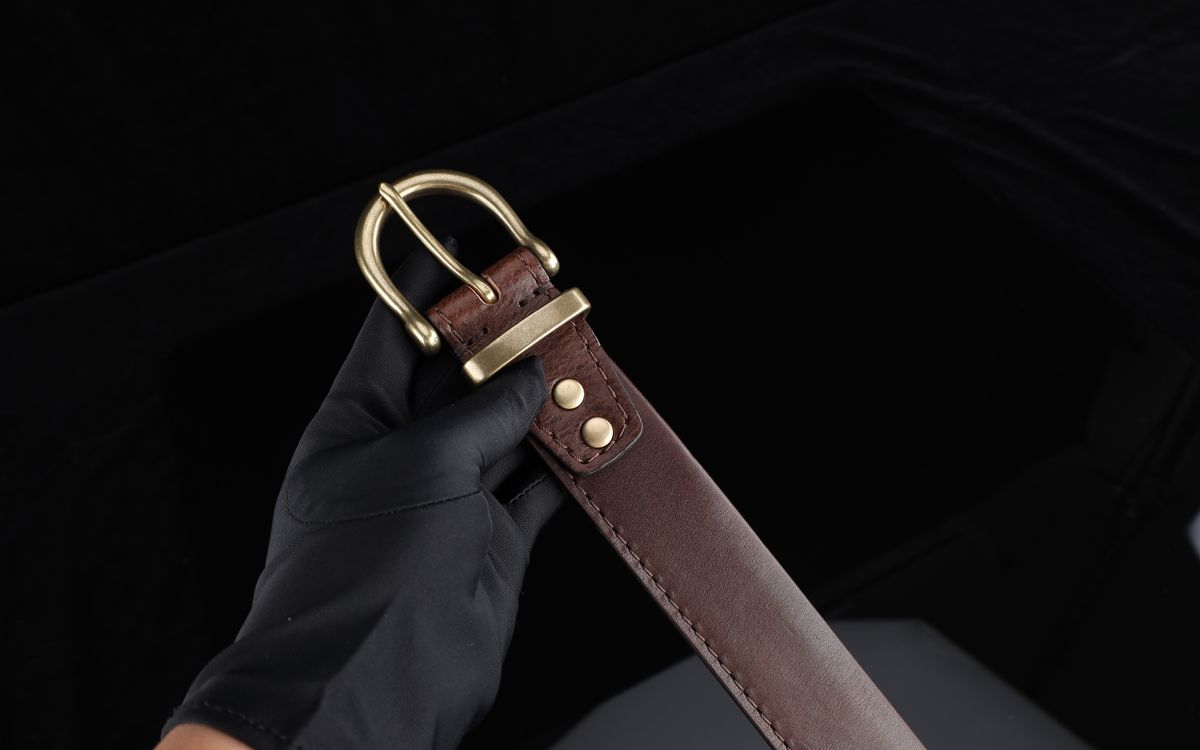
Leather labeling is a vocabulary problem before it is a quality problem: full-grain, top-grain, genuine, nubuck, and suede all describe where a piece of leather came from in the hide and what was done to its surface — not how good it is. Suede in particular gets misread as a downgrade when it is a surface choice. This guide maps the terms to hide anatomy, then checks three currently sold belts whose published specs make the vocabulary concrete.
Short answer
The leather terms describe layers and surfaces, ranked by how much of the hide’s original outer grain survives: full-grain keeps the untouched top surface, top-grain is lightly corrected or split beneath it, genuine is the lower split with a finished face. Suede is not on that ladder at all — it is any leather brushed on the flesh side to raise a nap, and its quality depends on the hide it came from. For straps and belts, smooth full-grain vegetable-tanned leather is the durable default; for texture, suede trades weather resistance for hand.
Where suede comes from: the other side of the hide
A hide has two working faces. The grain side is the outside the animal wore: the tight, densely fibered surface that carried hair, resisted the weather, and holds the follicle pattern that makes full-grain leather look the way it does. The flesh side is the interior: looser, softer fiber bundles running parallel to the surface, the side that in an untreated hide faces the muscle. Tanneries split or shave a hide to uniform thickness, and every split produces a grain-side piece and a flesh-side piece from the same animal.
Suede is what happens when the flesh side gets brushed with an abrasive wheel or belt until the fiber ends lift into a nap. The name comes from the French, and the material it imitates was originally Swedish gloveskin, but in modern trade usage suede simply means flesh-side-out leather. Because the flesh side is structurally the hide’s softer interior, suede is plusher, more porous, more absorbent, and less abrasion-tolerant than the same hide worn grain-side-out — everything that makes suede pleasant to touch follows from which face of the skin it is.
The grain-side ladder: full-grain, top-grain, corrected, genuine
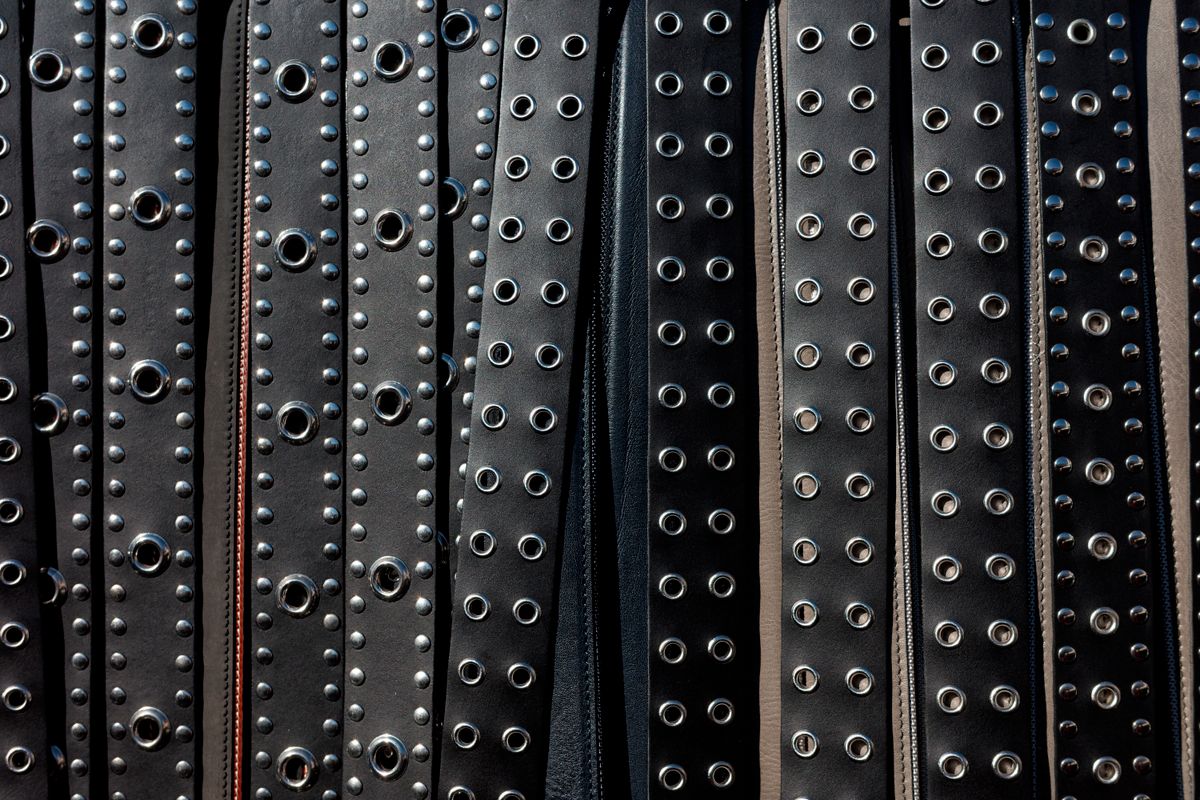
Grain-side leather sorts into a rough hierarchy by how much original surface survives. Full-grain leather has had nothing removed from the grain: follicle marks, healed scars, and range wear all stay visible, and the fiber structure at the surface stays intact, which is why full-grain is the most durable and the most responsive to patina. Top-grain has had the very top of the grain sanded or snuffed away to even out imperfections, then usually finished with pigment and an embossed or plain coat; it looks uniform and still wears well, but it no longer develops character the same way. Corrected grain goes further, sanding deeper flaws and rebuilding the surface with heavier pigment and artificial grain patterns. Genuine leather, as used on American retail labels, typically means the lower splits — layers below the grain with no grain surface at all, given a smooth, embossed, or coated finish to read as leather.
| Term | What was done | Surface you get | Typical behavior |
|---|---|---|---|
| Full-grain | Nothing removed from the grain | Natural grain, scars and all | Strongest fibers at surface; patinas with wear |
| Top-grain | Top of grain lightly sanded, pigment finished | Uniform, smooth | Durable; less patina, more consistent look |
| Corrected grain | Deeper sanding plus pigment and embossing | Artificial-looking grain | Even appearance; finish wears before fiber does |
| Genuine / split | Flesh-side layers below the grain, coated or embossed | Smooth, uniform, coated | Real leather; less dense, coated face can crack |
| Suede / roughout | Flesh side brushed to raise nap | Velvety, matte, porous | Soft hand; absorbs water; nap flattens with wear |
The belt-grade guide covers how this ladder maps onto retail price tiers and which of these words actually appear on strap labels.
Why suede is not a grade
The most common reading error in this vocabulary is placing suede below full-grain on the quality ladder. Suede is not on the ladder. The ladder measures how much grain surface survives; suede measures which face of the leather points outward. A tannery can brush the flesh side of a superb thick hide and produce suede that is better leather than a heavily corrected, pigment-coated grain surface made from the same skin. Roughout — grain-side leather worn flesh-side-out with nothing split away — makes the point at its extreme: construction boots and belts built roughout use the full thickness of a full-grain hide, nap outward, and outlast ordinary suede many times over.
Two related terms sharpen the picture. Nubuck is grain-side brushed leather: the durable outer surface lightly sanded to a fine nap, keeping full thickness and grain strength — closer to full-grain in durability than to suede, with a more velvety look. Split suede, by contrast, is a thinner layer cut from below the grain and brushed on both counts: it is the interior layer and it wears the interior face, which is why cheap split suede wears out fast. Thickness and layer origin, not the word suede, decide the outcome. Even the tanning chemistry runs orthogonal to the nap question — a vegetable re-tan nubuck and a chrome-tanned split suede share the word suede and almost nothing else.
Durability, water, and which face wears
Mechanically, the grain side is the hide’s armor: its fiber bundles are woven tight and angled to shed water and resist abrasion, which is why belts, soles, and straps have worn grain-out for as long as leather has been used. The flesh side is the hide’s cushion: looser fibers that hold air and flex easily, but that soak water readily and fuzz under repeated abrasion. Wear suede against denim edges and rain, and the nap abrades flat and water-spots; wear the same hide grain-out, and the surface burnishes instead of degrading.
The consequences are practical rather than moral. Suede is the right choice for texture against skin, for indoor footwear, and for color depth — nap scatters light and produces the saturated, matte tones smooth leather cannot. Smooth grain is the right choice for anything that meets ground, weather, or hardware. This is also why suede goods carry care instructions the smooth-leather ones do not: protective spray before wear, gentle brushing to lift the nap, and a deliberate avoidance of water and prolonged sun exposure are standard published guidance across suede makers, and they follow directly from the material’s open fiber structure rather than from caution for its own sake.
Weight and temper: reading leather in ounces
Leather thickness is sold in ounces, where one ounce corresponds to one sixty-fourth of an inch — a 8-9 oz hide is roughly an eighth of an inch thick. Weight drives temper: light leathers under 3 oz bend and drape for gloves and garments; midweights around 4-6 oz shape wallets and unlined straps; heavyweights from 8 oz up hold hardware and resist stretch, which is what a belt under load needs. Temper also depends on tanning: vegetable-tanned leather is firm and molds under heat and pressure, while chrome-tanned leather stays softer and more supple at the same weight.
| Leather weight | Approximate thickness | Typical goods |
|---|---|---|
| 1-3 oz | Under 3/64 to 3/64 inch | Gloves, garment linings, thin overlays |
| 3-5 oz | Around 1/16 inch | Wallets, watch straps, garment leather |
| 5-7 oz | Around 7/64 inch | Unlined belts, holsters, bag panels |
| 8-10 oz | Around 1/8 inch | Sturdy belts, soles, straps under load |
| 12-16 oz and up | 3/16 inch and thicker | Heavy belts, machinery belting, orthopedic work |
The numbers are ranges, and hides vary across their surface even within one side — a full-grain belt maker stating thickness to the hundredth of an inch is describing the hide’s average, which is why published specs on leather goods hedge with approximations more often than textile specs do.
How the two faces age
Smooth grain leather ages by burnishing: contact points polish, oils from handling darken the surface unevenly, and the grain’s original marks deepen into the mottled color change called patina. Full-grain vegetable-tanned leather does this most dramatically, which is the entire aesthetic argument for choosing it. Coated and corrected leathers resist patina because the pigment layer stands between the fiber and the world; when they age, the finish scratches and cracks before the fiber underneath does, which is why a coated belt looks newer longer and dies more suddenly.
Suede ages by wear patterns rather than patina: the nap flattens along contact points and stays lofty elsewhere, producing shiny-against-matte contrast that many owners read as character. It cannot be polished back — the fix is brushing, which lifts the flattened fibers upright again and resets the look. Suede also darkens permanently where water carries dirt into the nap, so its aging is more event-driven than time-driven. Neither path is worse; they suit different ownership styles, and the off-season storage habits that matter for wool apply to leather too in milder form — air circulation, no plastic bags, and stable humidity.
Three belts, compared on their published specs
Because the vocabulary is easy to misuse, three currently sold belts whose pages disclose hide details make the terms concrete — one full-grain grain-out strap, one heavy American nubuck, one lined European calf suede:
Hanks Xtreme Belt 1.5-Inch
Hanks Men’s 1.25-inch Comfortable Suede Leather Belt
Morjas The Belt Brown Suede
The Hanks Xtreme is the full-grain case study: its spec sheet states solid one-piece full-grain leather, USA-tanned North American steer hide, vegetable tanning, a leather weight of 16-17 oz, an approximate thickness of 0.23 to 0.25 inches, and a nickel-free stainless steel roller buckle secured with Chicago screws rather than snaps, under a 100-year warranty — the heaviest and most fully disclosed of the three. The Hanks suede belt demonstrates the grain-versus-flesh point inside a single maker’s line: its page lists heavy vegetable re-tan nubuck, solid one-piece full-grain leather, at 9-10 oz and roughly 0.14 inches thick — a nap-face belt built on the same full-thickness logic as the Xtreme, just lighter and brushed. The Morjas belt is the European suede construction: 30mm calf suede with a rounded solid brass buckle in matte gold and a vegetable-tanned leather lining, handmade in Spain — the lining adds the structural spine the thin calf suede does not supply itself, at USD 150 on the maker’s US site, the only one of the three with a reliably verifiable US price.
| Specification | Hanks Xtreme Belt 1.5-Inch | Hanks Men’s 1.25-inch Comfortable Suede Leather Belt | Morjas The Belt Brown Suede |
|---|---|---|---|
| Leather type | USA-tanned full-grain North American steer hide, vegetable tanned | Heavy vegetable re-tan nubuck, solid one-piece full-grain leather | 30mm calf suede, vegetable-tanned leather lining |
| Leather weight | 16-17 oz | 9-10 oz | Not stated (30mm width stated) |
| Stated thickness | Approx. 0.23-0.25 inch | Approx. 0.14 inch | Not stated |
| Buckle hardware | Nickel-free stainless steel roller buckle, Chicago screws | Antique nickel buckle, Chicago screws | Rounded solid brass buckle, matte gold |
| Construction | Solid one piece, interchangeable buckle | Solid one piece, interchangeable buckle | Handmade in Spain, lined |
| Warranty | 100 years | 100 years | Not stated |
| Stated price | Not verified | Not verified | USD 150 |
Reading leather labels honestly
The practical defenses against vocabulary abuse are few and checkable. First, thickness or weight beats adjectives: a strap that states its ounce weight and tanning method has already told you more than any “premium” claim can. Second, layer terms are hierarchical while surface terms are orthogonal, so a label reading “full-grain suede” is not a contradiction — it is a thick hide worn flesh-out, exactly what roughout construction has always meant. Third, coated uniformity is a sign of correction, not quality: real full-grain looks slightly irregular because hides are slightly irregular. Fourth, the verification chain matters where it exists — the fabric certification guide explains which third-party marks audit tanneries and chemistry, and the pre-purchase spec check lays out the five label lines worth confirming before ordering any garment or strap made of hide rather than fabric. A belt is the cheapest place to learn this vocabulary; the same words govern jackets and footwear at ten times the price.
The picks
Some links below are affiliate links — we may earn a commission at no extra cost to you.
Hanks Xtreme Belt 1.5-Inch
Solid one-piece full-grain North American steer hide, vegetable tanned and USA tanned, at 16-17 oz with a nickel-free stainless steel roller buckle on Chicago screws — the heaviest, most fully disclosed strap of the three.
Hanks Men's 1.25-inch Comfortable Suede Leather Belt
A nap-face belt done the durable way: heavy vegetable re-tan nubuck in solid one-piece full-grain leather at 9-10 oz — proof that suede is a surface choice, not a grade.
Morjas The Belt Brown Suede
A 30mm calf suede belt handmade in Spain with a rounded solid brass buckle and a vegetable-tanned leather lining that supplies the structural spine the thin suede does not carry itself.
Comparison
| Specification | Hanks Xtreme Belt 1.5-Inch | Hanks Men's 1.25-inch Comfortable Suede Leather Belt | Morjas The Belt Brown Suede |
|---|---|---|---|
| Leather type | USA-tanned full-grain North American steer hide, vegetable tanned | Heavy vegetable re-tan nubuck, solid one-piece full-grain leather | 30mm calf suede, vegetable-tanned leather lining |
| Leather weight | 16-17 oz | 9-10 oz | Not stated (30mm width stated) |
| Stated thickness | Approx. 0.23-0.25 inch | Approx. 0.14 inch | Not stated |
| Buckle hardware | Nickel-free stainless steel roller buckle, Chicago screws | Antique nickel buckle, Chicago screws | Rounded solid brass buckle, matte gold |
| Construction | Solid one piece, interchangeable buckle | Solid one piece, interchangeable buckle | Handmade in Spain, lined |
| Warranty | 100 years | 100 years | Not stated |
Specifications as published on the makers' product pages, checked November 2026.
Sources
- Hanks Belts product page for the Xtreme Belt 1.5-inch (hanksbelts.com, style AMA2755), for the full-grain North American steer hide, vegetable tanning, 16-17 oz leather weight, approximate thickness, roller buckle hardware, and 100-year warranty, checked November 2026
- Hanks Belts product page for the Men's 1.25-inch Comfortable Suede Leather Belt (hanksbelts.com, style A2740), for the heavy vegetable re-tan nubuck, solid one-piece full-grain leather construction, 9-10 oz weight, and approximate 0.14-inch thickness, checked November 2026
- Morjas US product page for The Belt Brown Suede with Gold Buckle (morjas.com/us), for the 30mm calf suede, rounded solid brass buckle, vegetable-tanned leather lining, handmade-in-Spain construction, and USD 150 price, checked November 2026
Frequently asked questions
- Is suede lower quality than smooth leather?
- Not inherently. Suede is a surface finish — the flesh side of the hide brushed to raise a nap — not a grade. A suede cut from a thick, tight hide can be better leather than a heavily corrected, pigment-coated grain surface. What suede does give up is weather resistance and abrasion tolerance on the exposed nap, which is why smooth grain leather dominates belts, straps, and anything worn against the elements.
- What is the difference between suede and nubuck?
- Both are brushed-leather surfaces with a nap, but they come from opposite sides of the hide. Nubuck is sanded on the grain side, the durable outer surface, so it keeps the hide's full thickness and its grain structure. Suede is brushed on the flesh side, the softer interior, which is more open and more porous. Nubuck therefore wears longer; suede feels plusher and velvety.
- Is genuine leather good leather?
- On a tannery vocabulary, genuine leather means real leather and nothing more — it usually denotes the lower split layers of the hide, below the grain, finished with an embossed or coated surface. It is real, it is affordable, and it is a step down from top-grain and full-grain, which carry the hide's actual outer surface. A belt stamped genuine can still serve for years; it will not develop the patina a full-grain belt does.